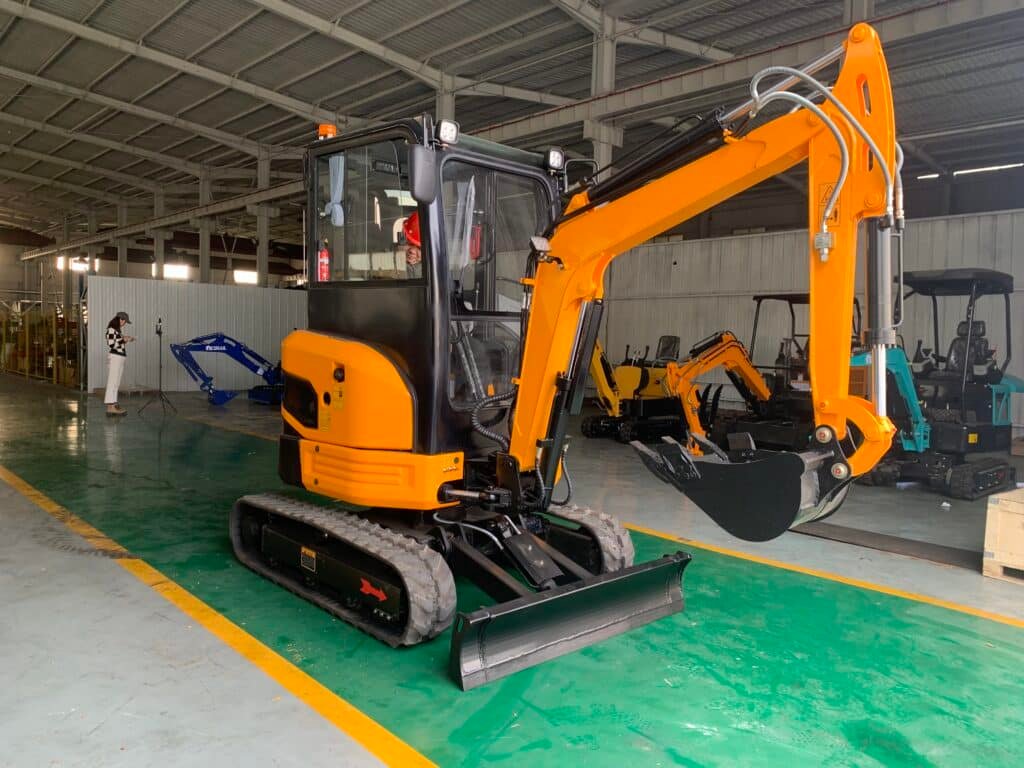
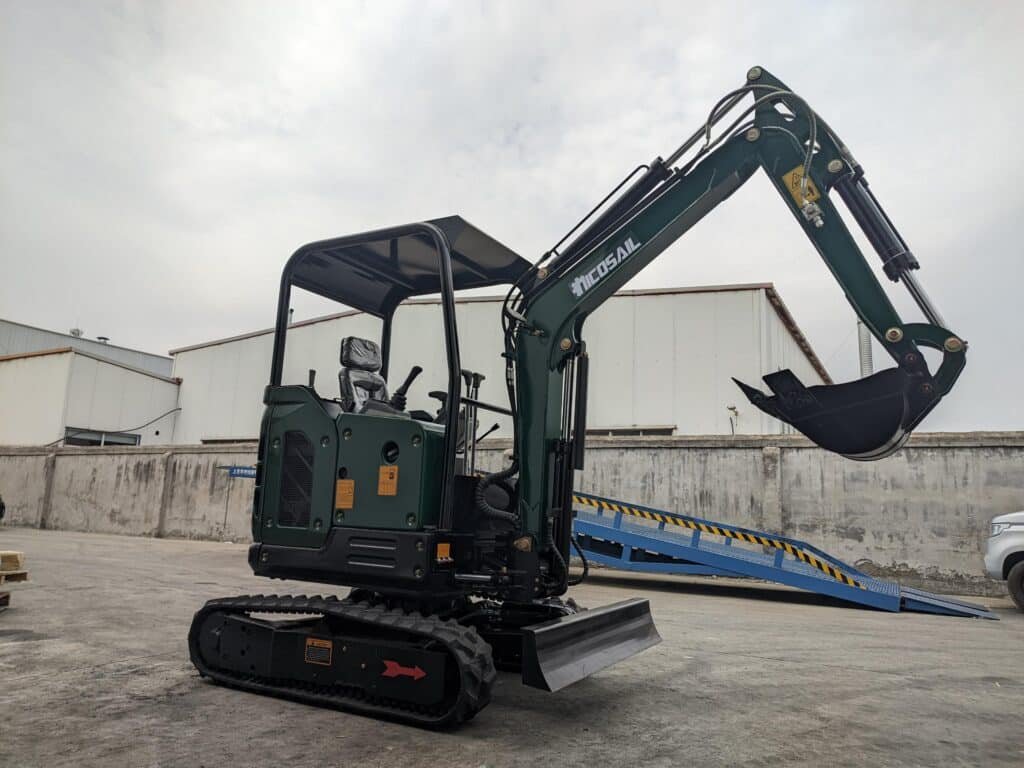
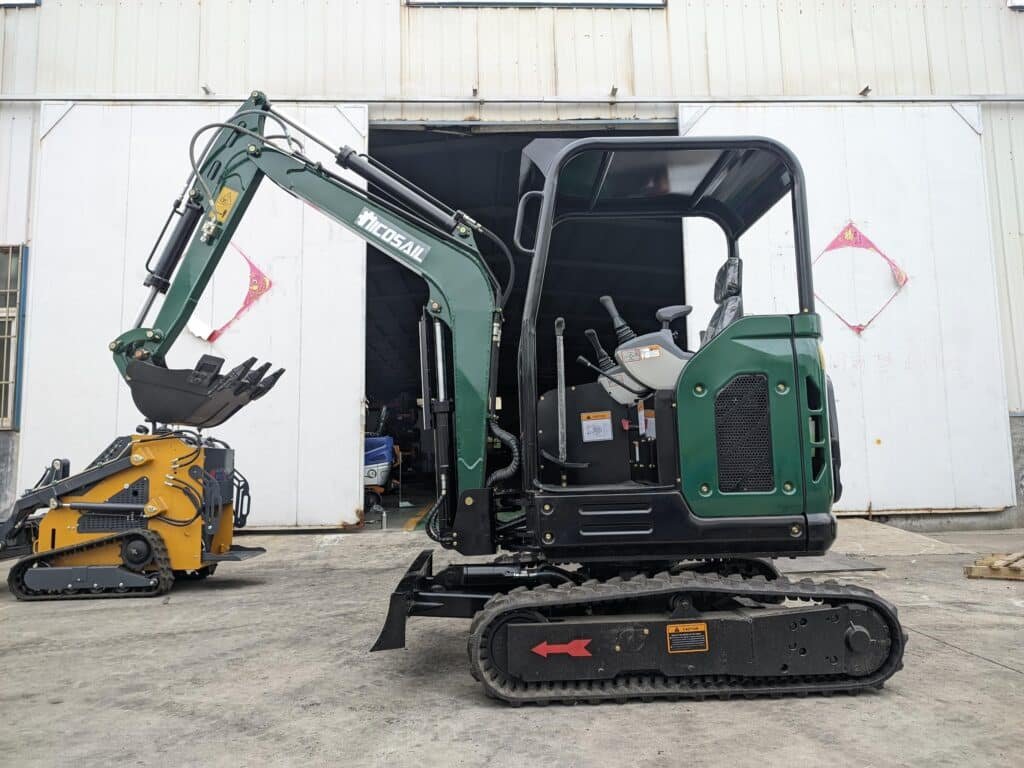
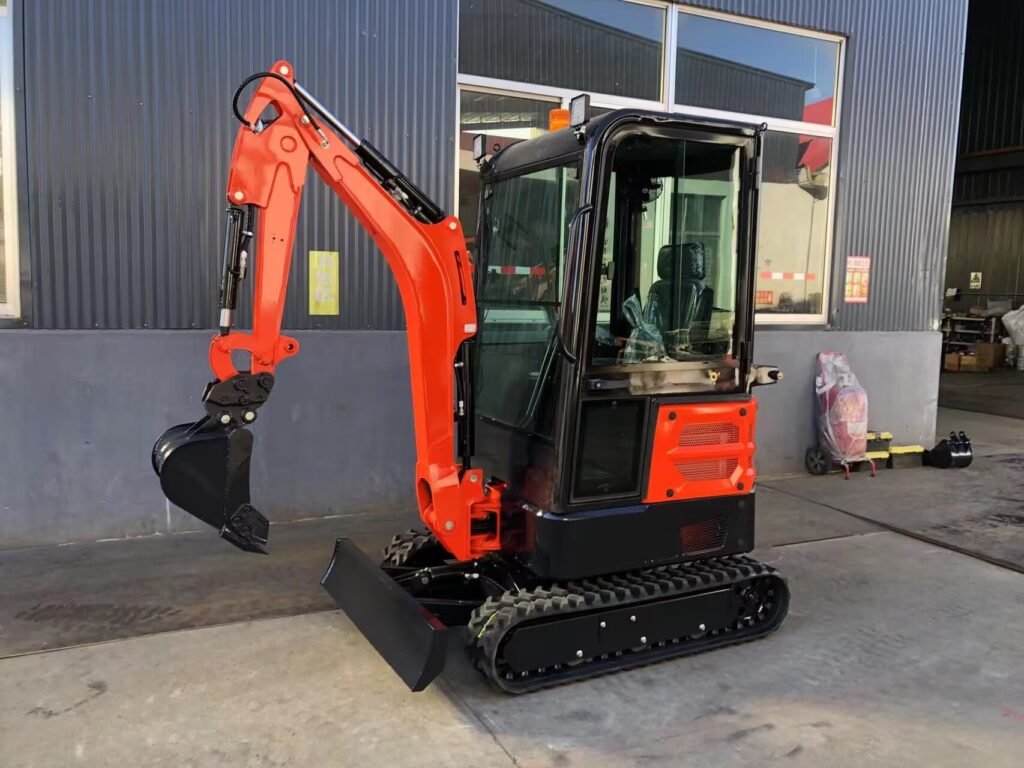
China Mini Excavator 2 Ton vs 2.5 Ton: How Tonnage Really Impacts Import Duty and Shipping Cost (And When It Doesn’t)
Table of Contents
1) What “2 ton” vs “2.5 ton” actually means in imports
When buyers say “2 ton” or “2.5 ton” mini excavator, they almost always mean operating weight (machine + standard equipment + fluids). It’s not payload, not shipping weight, and not “how heavy it feels.”
That matters because customs and logistics don’t price the same “weight.” You’ll see several different numbers on documents:
Operating weight (marketing + spec sheets)
Net weight (machine-only, often lighter than shipping weight)
CBM (cubic meters) (volume—often the biggest driver for LCL pricing)
Dimensions (decides if it fits certain container/door limits and how many units per container)
So the first takeaway is simple:
The 0.5-ton difference is often less important than the crate size and how many units fit in a container.
2) Does tonnage change the HS code (and duty)?
Most of the time for mini excavators: no.
Import duty is usually driven by:
HS/HTS classification (what the product is)
Country of origin (where it’s made)
Special measures (anti-dumping, countervailing, safeguard, Section 301, etc.)
How your destination country structures its tariff lines (some have weight thresholds, many don’t)
For a typical tracked mini excavator with a 360° rotating upper structure, many countries classify it under the family of codes for excavators with a revolving superstructure (commonly under HS 8429.52 in the global HS system; the last digits vary by country).
Key point: A 2.0t and a 2.5t mini excavator are usually the same product category to customs. Same function, same structure, same HS heading.
Where tonnage might change classification is when a tariff line is written with a threshold (for example: “operating weight exceeding X” or “engine power exceeding Y”). That happens more in some countries than others.
3) Where tonnage can change duty: real examples (Canada, Australia, US, UK)
Example A — Canada: the base duty may be the same across weights
Canada’s customs tariff shows 8429.52.00 (“Machinery with a 360° revolving superstructure”) with MFN duty = Free. So for Canada, 2t vs 2.5t typically doesn’t change customs duty (though GST/HST and brokerage still apply).
Importer takeaway: In a “duty-free” market, the landed-cost battle is usually won or lost in freight + local charges + compliance + service risk, not duty.
Example B — Australia: tariff lines can use operating-weight thresholds
Australia’s Chapter 84 tariff text shows a split under 8429.52:
8429.52.10 includes excavators “having an operating weight exceeding 12 t” and is shown as Free for that line;
8429.52.90 “Other” is shown as 5%.
A 2.0t or 2.5t mini excavator is below 12t, so it falls into the “Other” bucket in this structure—meaning the 0.5t difference does not change the duty rate in practice.
But this is a perfect illustration of the rule:
Even if your minis don’t cross a threshold, the tariff system in some countries is built with weight triggers, so you should always verify the exact tariff line.
Example C — United States: duty can be “Free,” but extra tariffs can dominate
A common surprise for US importers is this: the base HTS duty rate may be low or even “Free,” but additional tariffs can become the real cost driver for China-origin machinery.
For example, a US Customs ruling on excavators classified under 8429.52 notes a general rate of duty “Free,” while also listing an additional ad valorem duty of 20% under applicable trade measures for Chinese origin goods (as cited in the ruling).
Importer takeaway: In the US, tonnage usually doesn’t change the HTS classification for 2t vs 2.5t, but your origin-based add-on tariffs can swamp everything else. Always price landed cost using the current additional duty situation, not just the “general” column.
Example D — UK: weight thresholds show up in trade remedies (but not for minis)
The UK has had trade-remedy activity for certain excavators under commodity code 8429521000, and the official notice describing goods under registration explicitly references excavators 11,000 kg (11t) and above, and also explicitly says excavators below 11t are excluded from that investigation scope.
So for 2t–2.5t minis, that specific type of remedy scope would not apply—but it proves the concept:
Sometimes “tonnage” matters not because the HS heading changes, but because a special measure is written with a weight scope.
4) The shipping side: why 0.5 ton can move your freight bill more than you think
Even when duty is identical, the shipping cost difference between 2.0t and 2.5t can be real—mostly for boring, practical reasons:
4.1 Container loading count (the biggest lever)
For minis, the real question is often:
Can the factory load two units into a 20GP (or 40HQ) safely and legally?
Or does the larger machine force one unit per container (or fewer units per container)?
If a 2.0t model can ship 2 units in one 20GP but a 2.5t model ships 1 unit per 20GP, your per-unit ocean freight can jump dramatically—even if the weight difference looks small on paper.
What causes the “packing break”?
A slightly wider undercarriage
Boom/stick stowage geometry
Larger blade width
Higher canopy/cab height (door clearance)
Bigger crate footprint required by the factory’s packing standard
4.2 LCL vs FCL tipping point
If you’re shipping small quantities:
LCL (less-than-container-load) is priced mainly on CBM (volume), with weight used as a check (the classic “W/M” rules vary by forwarder).
A 2.5t machine often needs a slightly bigger crate → more CBM → higher cost.
If you can fill a container:
FCL (full container load) is usually priced per container, so the game becomes units-per-container.
4.3 Port handling and destination delivery equipment
That extra 500 kg often forces changes like:
Bigger forklift / higher-capacity yard handling
Different local delivery truck class
Higher lift fees at the final site (if the buyer doesn’t have equipment)
This doesn’t show in the ocean freight quote. It shows later as “local reality.”
4.4 Compliance packaging can change the cube
Some buyers insist on:
Steel-frame packing
Full plywood crate
Extra rust protection / desiccant / VCI wrap Those things add volume faster than they add weight.
5) Quick math: landed-cost comparison template (2t vs 2.5t)
Here’s a practical way to compare apples-to-apples. Build your landed-cost sheet like this for each model:
Step 1 — Customs side
Customs value basis (FOB / CFR / CIF, depending on your country rules)
Duty rate (based on HS + origin + special measures)
VAT/GST (based on your local rules—often applied on CIF + duty)
Reality check: In Canada, if MFN duty is Free for this category, duty may be 0. In Australia, minis typically sit under “Other” with 5% in the structure shown. In the US, an additional duty can be the big number even if base duty is Free.
Step 2 — Freight side (the part tonnage affects most)
For each model, get a quote with the same trade terms:
stable configuration control (so the machine you tested is the machine you keep receiving)
That’s why some importers lean toward manufacturers like Nicosail for mini excavators: not because of flashy claims, but because predictable packing + predictable specs = predictable landed cost and fewer after-sales headaches.
FAQ
1) Will a 2.5-ton mini excavator always have higher import duty than a 2-ton?
Usually no. Duty is driven by HS code, origin, and special measures—not by a 0.5-ton spec difference. Some countries do have weight thresholds in tariff lines (Australia shows a >12t split in 8429.52, for example), but both 2t and 2.5t sit below that threshold.
2) What HS code is typically used for mini excavators?
Many tracked excavators with a 360° revolving superstructure sit under the 8429.52 family (country suffix varies). Always confirm with your customs broker.
3) In Canada, is duty really 0% for this excavator category?
Canada’s tariff schedule shows 8429.52.00 (“Machinery with a 360° revolving superstructure”) with MFN: Free. (Still plan for GST/HST, brokerage, and local costs.)
4) In Australia, does tonnage matter for duty?
Australia’s tariff text shows a split under 8429.52: >12t can fall under a “Free” line (8429.52.10), while “Other” is shown at 5% (8429.52.90). But 2t and 2.5t are both below 12t, so they’re typically in the same bucket.
5) Why can shipping cost jump a lot from 2.0t to 2.5t?
Because the bigger model can push you into:
fewer units per container, or
higher CBM (crate size), or
higher destination handling and trucking costs.
The freight market doesn’t care about your brochure—it cares about space and handling reality.
6) What’s the fastest way to avoid “surprise” fees on arrival?
Ask for:
packed dimensions + gross weight
real loading photos
a forwarder quote based on those exact numbers
and have your broker confirm HS classification + any special measures in your country.
7) Do trade-remedy measures ever use weight thresholds?
Yes. The UK has official notices where excavator measures are scoped by operating weight (e.g., 11t and above), with below-threshold goods excluded. Minis are usually below such scopes, but it shows why checking the scope matters.
Summary
For most destinations, 2t vs 2.5t does not change the HS heading or the base duty—duty depends more on classification, origin, and special measures.
Tonnage can matter when a country’s tariff line or a trade remedy is written with a weight threshold (Australia’s >12t structure is one example; some UK remedy scopes reference 11t+).
Shipping cost is where the 0.5 ton difference can bite, mainly through crate size, units-per-container, and destination handling/trucking.
If the goal is the lowest landed cost with the least drama, treat “2t vs 2.5t” as a packing + logistics problem first, and a spec-sheet problem second.