How to Buy a Chinese Mini Excavator That Really Meets EPA Tier 4 & EU Stage V
Table of Contents
1. What “EPA / Stage V” Really Means (In Plain English)
“EPA” and “Stage V” sound very technical, but they are basically clean exhaust rules for diesel engines.
EPA – This is the emissions standard in the United States, made by the Environmental Protection Agency. For mini excavators, people usually talk about EPA Tier 4 (Final).
Stage V – This is the emission standard in the European Union and some nearby countries.
Both are about how clean the engine exhaust is (less soot, less NOx, fewer harmful gases).
For compact and mini excavators (around 0.8–6 tons), this usually means:
The engine must be from an approved brand
The engine must have emission certificates
In many cases, the exhaust system needs DPF/DOC/CEGR or similar technology, depending on power range
For a farmer, garden owner, or small contractor, the key point is simple:
If a Chinese mini excavator is EPA/Stage V compliant, it can be legally registered, insured, and used in the target country without trouble (subject to local rules).
2. Why Emissions Compliance Matters for Small Contractors & Landowners
Some users think: “This is just a small machine for my farm, why care about EPA or Stage V?” In reality, skipping compliance can cause real problems later.
2.1 Legal use and registration
In many countries:
Non-compliant engines cannot be registered as working machinery.
Some projects (especially public or municipal projects) only allow Stage V / Tier 4 machines on site.
Rental companies often require proof of EPA/Stage V before adding a machine to their fleet.
Even for a private farm or garden, if a government inspection happens or the machine is used near residential areas, unapproved diesel engines can bring fines or forced downtime.
2.2 Resale value
A mini excavator with a known compliant engine, clear labels, and certificates:
Sells faster
Keeps better value
Is easier to pass on to a contractor or rental company
A cheap, non-compliant machine might look like a bargain, but later can be difficult to sell, especially in Europe, the US, Canada, or Australia.
2.3 Job opportunities & site access
Many construction sites now check:
Engine plate (power, emission standard)
CE / EPA labels
Noise and exhaust level in sensitive areas
A compliant Chinese mini excavator lets small contractors:
Join more jobs
Work in city areas or near homes
Rent equipment to others with fewer worries
3. EPA vs Stage V vs “Tier 4”: Quick Cheat Sheet
These terms often get mixed, so a simple cheat sheet helps.
3.1 EPA Tier 4 (USA, Canada, etc.)
Covers off-road diesel engines, including mini excavators
“Tier 4 Final” is the current strict level for most new machines
Focus on reducing particulates (soot) and NOx
When a supplier says “EPA approved”:
The engine must have an EPA certificate
There should be an EPA label on the engine
The serial numbers on the label and documents should match the actual engine
3.2 EU Stage V (Europe)
Applies to non-road mobile machinery, including excavators
Even stricter in some power ranges than previous EU Stage IV
Many engines require DPF (Diesel Particulate Filter) for particulate matter
A Stage V compliant engine will have:
Stage V marking on the engine plate or label
A type-approval number
Supporting declaration and technical file at the factory
3.3 Tier 4 vs Stage V: Are they the same?
Not exactly, but they are similar modern clean-diesel standards.
A machine can be designed with an engine model that has both EPA and Stage V versions.
For buyers, the important part is:
If the machine goes to the US/Canada → need EPA
If it goes to EU/UK/European markets → need Stage V
4. How Chinese Mini Excavators Can Be Fully Compliant
Many small contractors think: “Chinese mini excavator = cheap = non-compliant.” This is not always true.
There are three typical setups seen in the market:
4.1 Non-certified “farm only” engines
Very low price
No EPA or Stage V approval
Often sold for markets with no strict regulations
These are not suitable for users in Europe, North America, or countries with modern emission requirements.
4.2 “Almost compliant” – partial or old certificates
Engine has old Tier 2 / Tier 3 / Stage IIIA certificates
Or the certificate does not match the exact engine model or power
Or only documents, no label on the engine itself
These engines may look OK on paper but still fail an inspection.
4.3 Fully compliant: EPA Tier 4 / Stage V engines
Quality Chinese factories now:
Work with well-known engine brands (for example, Kubota, Yanmar, Perkins, or reputable Chinese brands with real approval)
Get original documents from the engine supplier
Keep a traceable list of engine serial numbers for every exported machine
Brands like Nicosail focus on this “fully compliant” setup for markets such as Europe and North America, because most buyers there cannot risk non-compliance.
5. Key Engine & Machine Documents to Ask For
Even non-technical buyers can protect themselves by asking for specific, simple documents.
The serial numbers in the documents should match the photos.
5.2 For EU Stage V
Ask for:
EU Declaration of Conformity (DoC) for the machine
Stage V engine approval document (or at least the approval number)
CE marking on the machine nameplate
Instruction manual mentioning:
Emission stage
Engine type
Basic safety instructions
A serious factory will also have a technical file with noise tests, stability calculations, etc., but buyers usually only need the DoC and engine evidence.
5.3 Additional helpful items
Packing list & commercial invoice – should list “mini excavator”, model, and sometimes emission compliance remark
Photos/videos before shipment – good for confirming labels and configuration
Engine brand contact – in case local service is needed
Nicosail, for example, usually prepares a document package (manual + CE/EPA copies + photos) so end users can show them to customs, insurance, or inspectors when needed.
6. How to Quickly Spot Red Flags in Compliance
Many small owners are not engineers, but there are easy ways to judge whether a supplier is serious about EPA/Stage V.
6.1 Vague answers like “don’t worry, we can make certificate”
Be careful if:
The reply is “certificate can be arranged later”
Or “no problem, we have friend who can give certificate”
Or the seller cannot clearly tell which engine brand/model is used
Real compliance is built into the engine and machine design, not added at the last minute.
6.2 Engine photo with no visible label
A small plate or sticker on the engine is the ID card. If all photos:
Are very blurred around the label area
Or always show the other side of the engine
Or use photoshop-looking labels
better to ask for:
A close-up photo
Or a short video walking around the engine and zooming in on the plate
6.3 Certificates that don’t match the engine
Typical tricks:
Certificate for another engine model
Certificate for different power / RPM
Only one generic certificate shown for all machines
A careful buyer can simply check:
Is the engine model on the certificate the same as on the engine label?
Is the power similar to what the brochure says?
If the supplier can’t show matching details, that’s a warning sign.
6.4 Very low price for “EPA/Stage V”
True compliant engines are more expensive. If one supplier offers:
A machine with “EPA/Stage V engine”
At almost the same price as a no-name non-compliant engine
then something is probably wrong. A realistic price gap almost always exists.
7. Realistic Use Cases: Farm, Garden, Construction, Rental
Different users care about different things. Emissions compliance still matters for all of them, just in slightly different ways.
7.1 Farmers & ranch owners
Typical needs:
Dig trenches for water pipes
Clean ditches
Build or maintain farm roads
Handle small construction on the property
Reasons to choose EPA/Stage V:
Easier to insure the machine
Easier to resell later
Lower smoke and smell, better for working near livestock and living areas
A 1–2 ton compliant mini excavator from a factory like Nicosail can handle most farm jobs and sit comfortably on a small trailer.
7.2 Garden & landscape owners
Typical needs:
Landscaping, planting trees
Small ponds, garden features
Fence post holes
For gardens, neighbors can be very sensitive to smoke and noise. A clean engine with Stage V or Tier 4:
Smokes less on cold start
Smells less
Often runs quieter due to better design
This is important if work is done near houses, villas, or tourist areas.
7.3 Small construction contractors
Typical needs:
House foundations
Utility trenches
Driveway and yard preparation
Small demolition
If work is done in cities or near residential areas:
City regulations may require compliant machines
Project owners may ask to see certificates
Insurance companies may ask for documentation in case of accidents
With a compliant Chinese mini excavator, a small contractor can bid for more jobs while keeping equipment cost under control.
7.4 Rental business or equipment sharing
Even if a buyer is just a farmer now, it’s very common to rent the excavator to neighbors.
If the machine is EPA/Stage V compliant:
Rental contracts are easier to write
Users feel safer and more confident
Future law changes are less of a problem
Brands like Nicosail tend to design models with quick maintenance access and standard service parts, making them better suited for small rental fleets.
8. Working With Chinese Factories the Smart Way (Example: Nicosail)
Not all Chinese suppliers are the same. The key is to work with a real factory that understands emissions rules, not just a trading company chasing lowest cost.
8.1 What a serious factory usually has
A serious mini excavator factory usually:
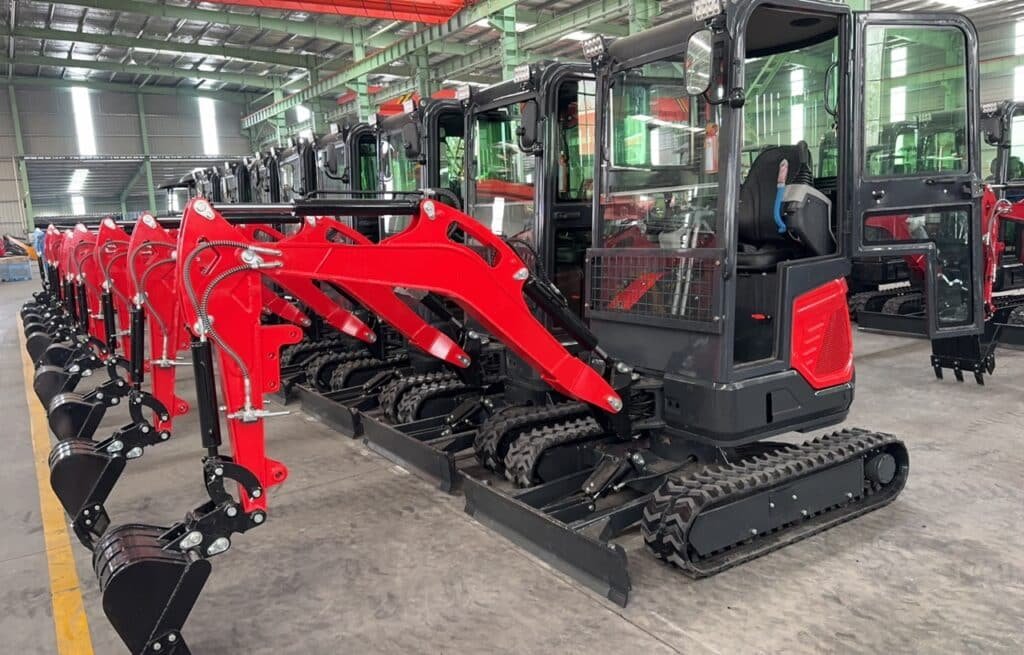
Runs multiple production lines dedicated to different tonnage and emissions versions
Has incoming inspection for engines and key hydraulic parts
Performs EOL (end-of-line) testing for every machine (leak tests, functional tests)
Keeps build records – which engine serial number went into which machine
Nicosail, as an example, positions itself as a factory with 5 production lines, focusing on mini excavators, compact tracked loaders, and skid steer loaders. For markets like Europe and North America, models are matched with relevant emission-compliant engines and supporting documents.
8.2 Why direct factory cooperation helps with compliance
Easier to trace engine origin and serial number
Possible to customize: EPA version for US, Stage V version for EU
Faster to get technical answers when customs or inspectors ask questions
Better chance of consistent quality (same welding process, paint, hydraulics)
For small contractors and landowners, this means less risk of surprises at the port and more confidence in long-term use.
8.3 Balancing price with compliance
A fully compliant EPA/Stage V machine:
Costs more than a non-compliant one
But still usually cheaper than big brand machines from Europe or Japan
Gives a better total picture: lower risk, legal use, higher resale
Chinese factories like Nicosail work to keep a good balance: not the absolute cheapest in the market, but focused on solid structure, reliable hydraulics, and legal engines.
9. Simple Step-by-Step Buying Checklist
Here is a practical checklist that even a non-technical buyer can follow.
Step 1 – Decide target region and rules
Will the machine work in USA/Canada? → Need EPA Tier 4 compliant engine
Will it work in EU/UK/European countries? → Need Stage V engine
Mixed use (e.g. export or second-hand sale) → Better to choose the stricter, newer standard
Step 2 – Confirm engine brand & model
Ask the supplier:
Exact engine brand
Exact engine model
Rated power (kW or HP)
Emission standard (EPA Tier 4, Stage V, etc.)
A clear answer is a good sign.
Step 3 – Request documents & photos
Ask for:
Engine certificate (EPA or Stage V) – at least a copy
Close-up photo or video of the engine label
Machine nameplate with CE marking (for EU)
Draft Declaration of Conformity for Stage V/CE machines
Compare data: same engine model, similar power, matching series.
Step 4 – Check price logic
If compliant engine version is only slightly more expensive than non-compliant competitors, be careful.
A realistic compliant machine will usually have a noticeable but reasonable extra cost.
Step 5 – Check factory capabilities
A few simple questions help:
How many mini excavators are produced per month?
Does the factory have experience shipping to USA, Canada, Europe, Australia?
Can they share any reference photos or videos from other customers?
Factories that ship regularly to regulated markets usually have standard procedures for documents, which reduces hassle.
Step 6 – Confirm shipping & customs details
For small buyers:
Ask whether machine is shipped assembled or partially knocked down
Confirm HS code and description on documents
Check if any special inspection is needed in destination country
Some suppliers, including Nicosail, can help prepare customized invoice wording and basic guidance to support smooth customs clearance (within legal limits).
Step 7 – Keep all documents safe
After receiving:
Save digital copies and paper copies of all certificates
Keep photos of nameplates and labels
Store everything together with the purchase invoice
This makes resale, insurance claims, or inspections much easier in the future.
10. FAQs About EPA / Stage V Chinese Mini Excavators
Q1: Is it legal to import a non-EPA Chinese mini excavator to the USA just for “private farm use”?
Rules vary, but in many cases off-road diesel engines still must comply with EPA rules even for private use. Using non-compliant machines can cause trouble if inspected or if accidents happen. For long-term use and future resale, choosing an EPA Tier 4 compliant machine is strongly recommended.
Q2: How to tell if the engine is really Stage V or EPA and not just a sticker?
Check three things:
The engine label – should clearly mention EPA Tier or Stage V.
The engine model and power – should match the documents and brochure.
The certificate or type-approval – engine model on paper must match the one on the engine.
If something does not match, ask for clarification or choose another supplier.
Q3: Does a Stage V / EPA engine need special fuel or oil?
Most modern compliant engines still use standard diesel (sometimes recommended low-sulfur fuel) and normal engine oil type recommended in the manual. Just follow:
Correct oil grade and replacement interval
Good quality diesel
Regular cleaning of air and fuel filters
The instruction manual from the factory or engine brand will list the exact requirements.
Q4: Is a Stage V / Tier 4 machine harder to maintain?
Not necessarily. For compact machines with smaller engines, the after-treatment system is usually simpler than big excavators. Basic maintenance includes:
Regular oil and filter changes
Keeping cooling system clean
Using good fuel
Following any regeneration or cleaning instructions for DPF (if equipped)
Nicosail and similar factories typically provide clear maintenance schedules in the user manual, so non-professionals can follow them step by step.
Q5: Can a Chinese mini excavator with a compliant engine work on big construction sites in Europe or Canada?
In many cases, yes – if:
The engine is truly Stage V or EPA Tier 4
The machine has proper CE/EPA documentation
The site rules do not specifically require a certain brand
Some big contractors might prefer well-known premium brands, but for smaller sites, farms, landscaping, and utility work, a compliant Chinese machine is usually acceptable.
Q6: What about warranty and spare parts for a Chinese compliant engine?
This depends on the engine brand and the factory’s support policy. Good practice is:
Engines from known brands (including strong Chinese brands) often have service partners or parts channels in many countries.
Factories like Nicosail provide a warranty period for the whole machine and support parts shipment when needed.
Before buying, ask:
Warranty duration (usually 12 months for main parts)
How to buy filters, belts, injectors, etc. later
Whether there is a parts book or code list
Q7: Is it worth paying extra for EPA/Stage V if the machine will stay only on private land?
Most users who plan to use the machine more than 3–5 years or consider later resale find it is worth it, because:
Resale is easier
Risk of legal changes is lower
Fuel efficiency and smoke levels are better
The extra cost up front can be seen as a “future-proof” fee.
11. Final Summary: Compliance Made Easy
EPA and Stage V may sound like complicated topics, but for farmers, garden owners, and small contractors, the core idea is simple:
EPA (USA/Canada) and Stage V (Europe) are clean exhaust standards for engines.
A mini excavator with a real compliant engine is easier to import, register, insure, and resell.
Chinese factories are capable of building fully compliant machines, especially when they use approved engines and keep proper records.
Buyers do not need deep technical knowledge; just need to:
Confirm engine model & standard
Ask for clear documents and photos
Check that data matches between engine, certificate, and machine
Work with a reliable factory rather than the lowest-price trader
Brands such as Nicosail focus on mini excavators, compact tracked loaders, and skid steer loaders, and offer models equipped with EPA Tier 4 / Stage V engines for regulated markets. For small business owners and land users, this brings a good balance of price, reliability, and legal compliance.
With a little attention at the buying stage, emissions compliance really can be “made easy” – and the result is a mini excavator that works hard, passes inspections, and keeps its value for many years.